
For seasoned producers, solo filmmakers and brand teams who value time, cost efficiency and high standards

One strategic debrief session for your audio-visual project – full pack of project briefs in no time.

Upload what you have – email, notes, script ideas. DebriefStudio asks questions that bring you clarity and depth. In minutes you get a pack of: a clear scope, the questions still open, a brief for key departments, a schedule and a budget range. Save hours of reading, prevent early mistakes in planning and budgeting, and raise the standard of how the production job starts.

  • Debrief summary — the agreed scope
  • Reply email to the client
  • Open questions and contradictions
  • Brief per department / supplier
  • Schedule and budget range
  • Kickoff checklist
One complete debrief pack
$9one-time

No subscription. Start whenever the next job lands.

Get your first debrief pack — $9 →
No subscriptionCredits never expire14-day refund
A short film-style preview of the DebriefStudio workflow

What you get for $9

One debrief session. Six documents. Ready to send.

A pack is one audio-visual project, fully debriefed and written up. Every document is editable, copyable and exportable to PDF or Word, and each one can be produced in a different language from the others.

01Scope

Debrief summary

The whole job written out once: what is being made, in which formats, by when, and what is still unclear.

02Scope

Debrief email

The reply you send back to whoever gave you the job, with the open questions attached.

03Craft

Department briefs

One brief per department — directing, camera, art, wardrobe, sound, post — sent to the right head.

04Logistics

UPM brief (unit production manager)

The logistics read: crew, locations, permits, kit, and what must be confirmed before a quote can hold.

05Logistics

Schedule & budget range

Proposed shooting days and a cost range with the drivers named.

06Craft

Kickoff checklist

What to lock first, in order, plus a deliverables tracker you keep updating.

From source material to briefs

What goes in, and what comes back.

The material you already have

Email
“Hi — we'd like a short documentary series about the three river towns, something for the funding application and also for social. Budget is not confirmed yet. Can you send us a proposal by the end of next week?”

Procedure.pdf
41 pages of eligibility rules, cost categories and reporting obligations.

Director's note
Three pages of intentions, references and a wish for aerial work in every town.

Locations.docx
A list across three countries, with no travel days costed.

What comes back, in about ten minutes

  • Debrief summary — scope, deliverables, formats, durations, rights, timeline, assumptions
  • Open questions — the eleven things nobody has answered yet
  • Debrief email — the reply, with those questions attached
  • Department briefs — directing, camera, sound, post
  • UPM (unit production manager) brief — crew, travel, permits, kit, what blocks a quote
  • Schedule — proposed shooting days per country
  • Budget range — with the cost drivers named
  • Kickoff checklist — what to lock first, in order

Same pack whether the job is a one-day social shoot or a multi-country production in development for funding.

Pick your situation

Three people use this, for three different reasons.

You are the one who turns a pile of material into one clear plan.

What this actually looks like

  • You are juggling development documents, funding rules, location lists and crew notes — in different files, updated at a different time.
  • You rewrite the same scope for many audiences: client, financier, crew head, supplier.
  • A brief change means unpaid hours re-reading sources to find what moved, and a missed detail can cost the production.

What you get out of it

  • One scoped debrief built from every document you upload
  • UPM (unit production manager) brief, department briefs, schedule and budget range
  • Compare update: paste the change, see what moved, rewrite only what it touched
  • Depth set to Professional — terse, assumes your vocabulary

I already have my own templates and I'm faster in them.

Templates give you the shape. This reads across every file and fills the shape in about ten minutes. It is built for real budgets: half-million-dollar productions and development work for funding applications, not only small jobs.

Get your first debrief pack — $9 →

Haven’t generated anything yet? Cancel within 14 days and get a full refund, no reason needed. Your pack includes regenerations, and the $9 is credited towards a monthly plan if you subscribe later.

Also used by production companies and studios setting a house standard, DoPs and production designers rebuilding a general brief into a department one, and AI-video teams scoping generative and hybrid pipelines.

Inside the app

This is the actual workspace, not a mock-up.

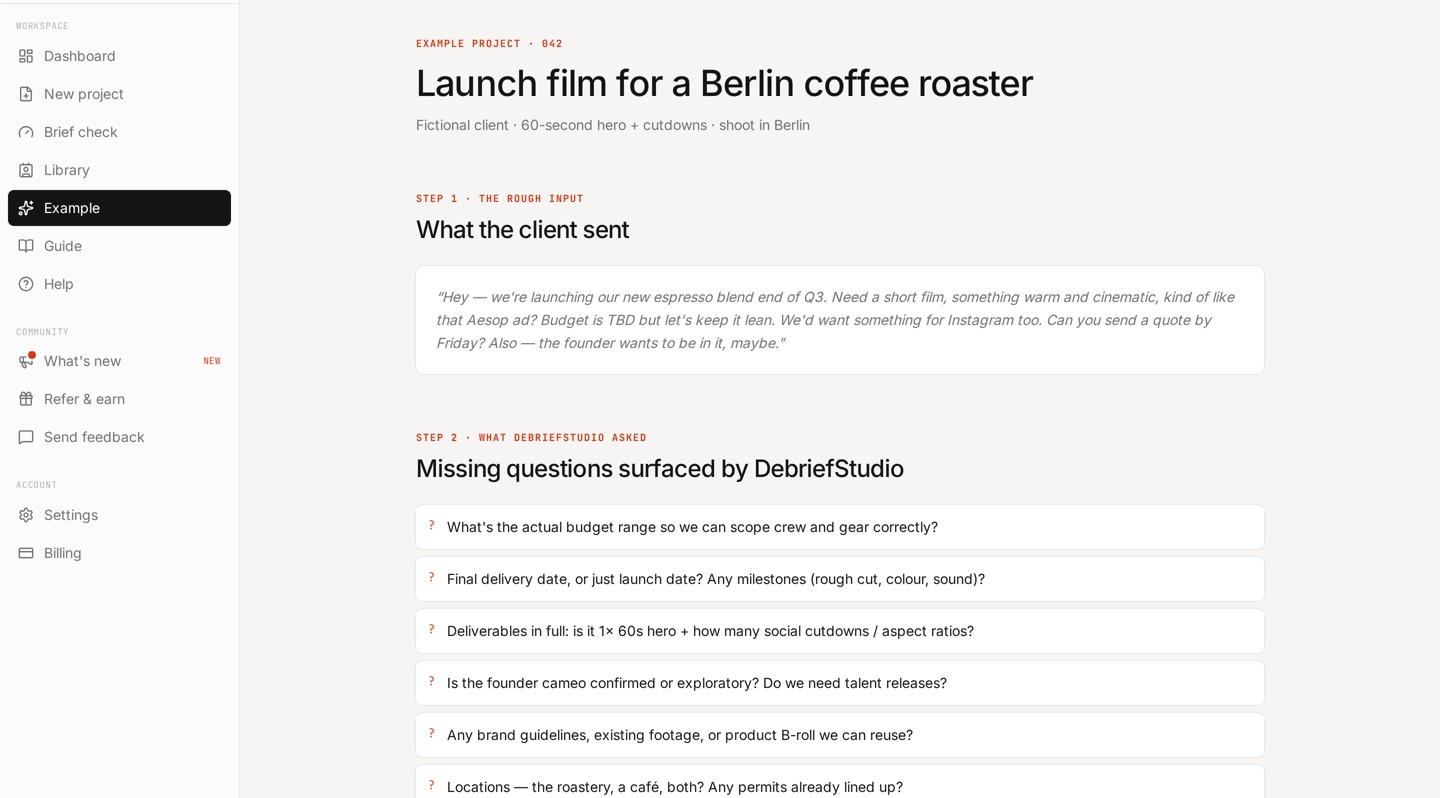
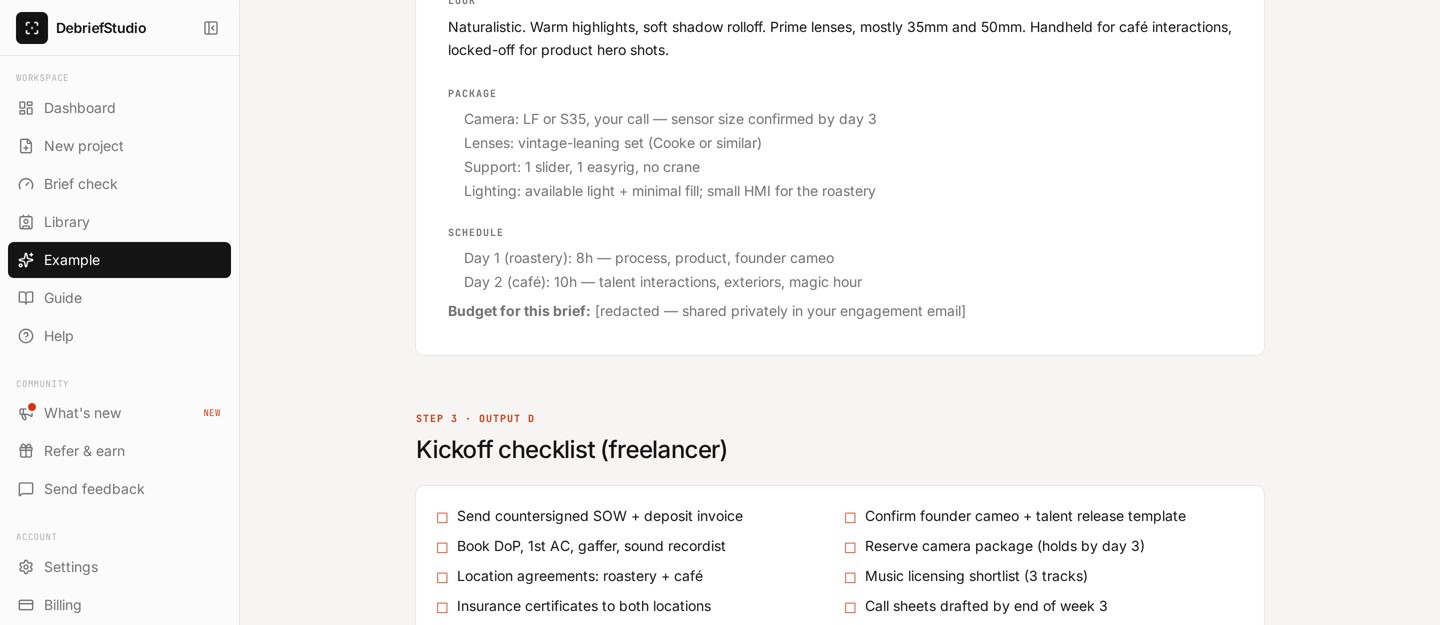
First, a rough client request and the questions DebriefStudio put back to it. Then two of the finished documents from the same session — a department brief and a kickoff checklist.

DebriefStudio workspace showing a rough client request and the questions the app surfaced from it
Step 1–2 · the request, and what it left out
DebriefStudio workspace showing a camera department brief and a freelancer kickoff checklist
Step 3 · department brief and kickoff checklist

A worked example

See the real documents, exactly as they come out.

Abbreviated, from the river-towns job above. The real pack is longer and carries every section listed earlier.

Debrief summary — excerpt

Project. A three-part documentary series (approx. 24 min per episode) on the three river towns, with a secondary set of short vertical cutdowns for social. Primary purpose is the funding application; broadcast and festival use is stated as an intention, not a commitment.

Deliverables. 3 × 24 min master, 16:9, stereo; 9 × 30–45 s vertical cutdowns, 9:16; one 3-minute teaser for the application file. Subtitles in three languages. Delivery formats not yet specified by the funder — flagged.

Assumptions made. Aerial work is treated as one unit shared across the three towns, not per town, because the director's note requests it everywhere while the location list implies a single travel loop. This is the single largest swing factor in the budget.

Open questions (4 of 11).
1. Is the funding decision date fixed, and does the shoot depend on it?
2. Which cost categories in the procedure are ineligible for crew travel?
3. Are archive rights required in perpetuity or for the grant period?
4. Who clears drone permits in each of the three countries?

Camera department brief — excerpt

To: Director of Photography

The job in one line. Observational documentary across three towns, single-camera, small crew, travelling as one unit with a fixed aerial block.

What is fixed. 16:9 masters and 9:16 cutdowns from the same material — frame with the vertical crop in mind from day one. Handheld for interiors, tripod for the interview set-ups.

What is not decided. The aerial provider is unconfirmed in two of the three countries. Assume you may lose the aerials in one town and plan a ground alternative for the opening of each episode.

Confirm back. Kit list and whether the vertical crop changes your lens choice; travel weight limits for the shared unit.

How it works

Three steps, about ten minutes.

Step 01

Upload your source material

Client email, Slack thread, rough script, procedure documents, director's notes, location lists. PDFs, Word files and images all work.

Step 02

Answer what's missing

DebriefStudio runs the debrief: it spots the gaps and contradictions — budget, deliverables, timeline, rights — and asks about them in a sensible order.

Step 03

Get the pack

Six documents, editable, in the language you choose per document, exportable to PDF or Word. Five regenerations included.

When the brief changes mid-job, paste the update and DebriefStudio shows what moved and rewrites only the documents affected.

Built for private work

Unreleased ideas, scripts and brand work stay with you.

Private by default

Only you see your projects.

Every project is scoped to your account with row-level security. Nothing is shared with other users.

Confidential mode

NDA-safe redaction.

Flag sensitive terms — client, talent, brand, product codenames. They are replaced with placeholders before anything is sent for processing, then swapped back for you.

No training

Your IP stays yours.

Your work is never used to improve anyone's models. Requests go through a platform whose provider contract prohibits training on inputs or outputs.

Straight answers

The four things people ask before buying

Why not just use ChatGPT?+
You can, and you will get one document that reads well. What you won't get is the same structure every time, department briefs addressed to the right people, a budget range with drivers named, redaction of client and talent names before anything is processed, or a compare view when the brief changes. This is the structured debrief, not the sentence generator.
I have my own templates and I'm faster in them.+
Templates are the shape. The slow part is reading forty pages of source material and deciding what belongs where. That is the part this does — and it fills your kind of shape, at the depth you set.
Is it for beginners or for large productions?+
Both, and the setting is called Depth. Guided explains every field and asks what an experienced producer would ask. Professional is terse and assumes the vocabulary. The same engine handles a one-day social shoot and a multi-country series in development for funding.
Is my work private?+
Yes. Projects are scoped to your account. Confidential mode replaces client, talent and product names with placeholders before processing and restores them only in your view. Nothing is used to train models.

FAQ

Everything else

Is there a free plan?+
No. Instead of a stripped-down version of the work, the example above shows the real output structure, so you can see the standard before you decide. And the $9 you spend on your first pack is credited towards a monthly plan if you later decide to subscribe, so trying it costs you nothing extra.
What exactly is one pack?+
One project, written up completely: debrief summary and open questions, the client email, per-department briefs, the UPM (unit production manager) brief, a schedule, a budget range and a kickoff checklist. You buy the pack, not a subscription, and you start it whenever the next job lands.
Do I have to subscribe?+
No. $9 buys one pack outright. If you later move to a monthly plan, that $9 is credited towards your first month — so the single pack is a way to try the full thing, not a detour. Monthly plans and multi-project packs are for people briefing several jobs a month; you can compare them any time from the pricing link in the top bar.
Can I work in another language?+
Yes. The interface stays in English, but you can paste source material in any language and choose the output language per document — the client email in one, the crew briefs in another.
Does DebriefStudio work for AI video creators?+
Yes. The same intake and brief structure applies whether you are shooting on RED or building a generative pipeline — the outputs follow the deliverables you describe.
What happens if the brief changes mid-job?+
Paste the update. DebriefStudio shows what moved against the previous version and rewrites only the documents the change touches. Rewrites use the regenerations included with your pack; when those run out, you can buy another pack or move to a monthly plan and keep going in the same project.

Who built this

Made by working producers, not by a software company.

DebriefStudio is built by a team led by a computer scientist with an MS in Computer Science, who also taught commercials production and creative advertising strategies at university level. The product side works hand in hand with working producers — more than twenty years on set and in the production office, including a partner with close to forty years in the business. Every document in the pack exists because one of us has had to write it under deadline, from material that was nowhere near ready.

That is also why the privacy rules are strict: we know what it means to hand someone an unreleased idea. Nobody on our side reads your projects, and your material is never used to train a model.

One debrief session

Run your next audio-visual project through one debrief session.

$9 for one complete debrief pack. No subscription. Daily brief checks included.

Get your first debrief pack — $9 →

Haven’t generated anything yet? Cancel within 14 days and get a full refund, no reason needed. Your pack includes regenerations, and the $9 is credited towards a monthly plan if you subscribe later.

See all plans and packs

What the $9 does not do

  • Nothing renews. It is a one-time purchase, not a trial.
  • No card is kept on file after the payment.
  • No plan choice to make now — the $9 is credited towards a monthly plan only if you decide to subscribe later.